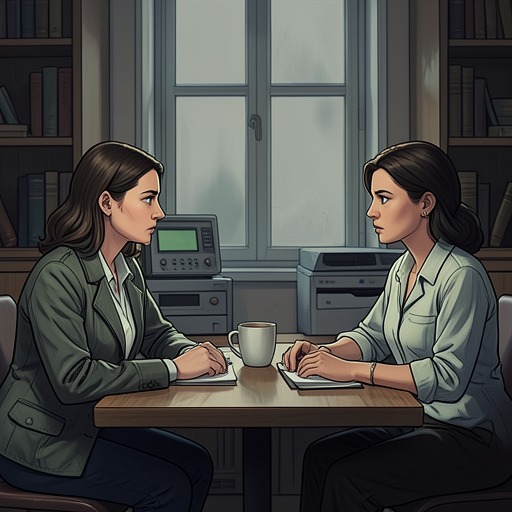
Amanda and Ruth’s relationship from wariness to cooperation
Leave the World BehindAmanda and Ruth’s relationship takes shape inside a house neither woman can experience as fully secure: Ruth and G. H. need shelter, while Amanda and her family have been forced to share their home with people they barely know during a blackout. Amanda initially reads the unexpected arrival as a possible threat and resents the intrusion; Ruth responds by trying to put her at ease. Their movement from suspicion toward cooperation is practical rather than intimate, built in the kitchen through hospitality, childcare concerns, food, and conversation. The uncertainty outside does not erase their differences, but it makes their shared dependence increasingly difficult to ignore.
An Uneasy Welcome
When Ruth and G. H. arrive, Amanda is furious, especially with Clay, and fears that the visitors might make demands. She wishes she still had the telephone and thinks about how long it might take the local police to reach the remote house. Her suspicion is not resolved by G. H.’s explanation that they would have called: Amanda privately questions whether they even have her number. The visitors’ presence therefore begins not as a freely chosen social encounter but as an intrusion whose circumstances Amanda cannot verify.
Ruth takes the first conciliatory step by introducing herself and extending her hand. She understands this as a role to perform: one person in a couple must manage the greeting and make the hosts feel at ease. Amanda notices the social gesture but is not persuaded by it. Even the word unannounced, used to acknowledge their arrival, strikes her as inadequate to what has happened. The handshake establishes civility before trust; it does not remove Amanda’s sense that she and her family have lost control of their own home.
Clay proposes that they sit, and Amanda agrees while directing the group toward the kitchen and asking them to keep quiet because the children are asleep. The request sets an immediate boundary around the family’s private life. Ruth accepts the arrangement, and G. H. acknowledges the children. Clay’s joke that Archie could sleep through a nuclear bomb lightens the exchange, but Amanda’s concern remains practical: the adults must manage the visitors without waking or alarming the children.
Shared Space and Cautious Cooperation
The decision to let the visitors stay is itself a point of tension between Amanda and Clay. Clay says they can refuse if he gets a bad feeling, but argues that they should offer shelter if he does not; Amanda does not share his faith in other people. His appeal to doing the right thing does not mean that Amanda feels secure or warmly disposed toward the guests. Rather, the household’s hospitality begins as a moral choice made under uncertainty, with Amanda expected to live alongside the consequences before she knows the full story.
That uncertainty is mutual. Ruth is frightened by the sudden disappearance of the familiar order and recognizes that ordinary life depends on people continuing to act as if its arrangements will hold. She does not have a reliable explanation for what has happened, and neither does Amanda. Their different positions in the house thus contain a resemblance: Amanda fears what the visitors might want, while Ruth fears what the wider emergency might mean. Clay offers reassurance, but his confidence that they will learn more the next day cannot supply information either woman actually possesses.
The domestic routines they share are correspondingly unsettled. Ruth’s usual sense of arrival at the vacation house depends on familiar possessions and habits; in the present circumstances, those routines have been displaced. She eventually showers and changes into clothes found in the house, but feels awkward about appearing before the people upstairs in them. Amanda’s home is shelter for Ruth, yet sharing it does not make Ruth feel at home. This discomfort marks a limit to their cooperation: they can occupy the same space and meet one another’s needs without either woman forgetting the unequal positions of host and guest.
Work, Food, and Conversation
Their most sustained cooperation develops around ordinary tasks. When Amanda considers making lunch, Ruth gets up and offers to help. Amanda does not particularly want her company, but accepts it partly because a shared activity may keep her from dwelling on Clay’s absence. Ruth, too, is unsure whether she wants to cook or feels expected to do so. The scene makes their assistance real without pretending it is uncomplicated: domestic labor gives them something useful to do together, while convention and anxiety shape who offers and who accepts it.
Their talk about work briefly gives them a social subject beyond the blackout. Amanda explains that she works in advertising on the client side, managing relationships. Ruth says she is retired and previously worked in admissions at Dalton School. Amanda immediately considers whether Ruth’s experience might offer an advantage to her children, who she considers wonderful but not exceptional. Her interest therefore mixes conversation with a parent’s calculation about opportunity. The exchange shows Amanda searching for a possible connection, but also reveals how quickly she assesses what a stranger might mean for her family.
In the kitchen, Amanda melts butter for sandwiches while Ruth brings out onion dip. Ruth offers to set aside a sandwich for Clay, and tears come to her as she thinks of him and wants him back with news. Amanda breaks their silence by asking what Ruth thinks is happening outside. Ruth does not speculate; she answers that Clay will return and find out something. Her response sidesteps the question, but Amanda has already identified what makes their situation so disorienting: without phones, people are cut off from the devices through which they usually check weather, time, and the surrounding world. The exchange does not give either woman an explanation. It does make their shared dependence on absent information explicit.
From Formality to a Limited Alliance
Ruth says she does not want the children to be frightened, and Amanda likewise insists that she does not want them to panic over nothing. Amanda is careful not to imply that Ruth and G. H. have already frightened them. This restraint matters: even while suspicious, she distinguishes her own wish to protect the children from an accusation against her guests. Ruth’s experience as a former school admissions worker informs her view of childhood, but being a grandmother has made her softer. The women do not share identical ideas or histories; they do share a concern about what adult fear might do to the children.
Later, Amanda brings out wine and distributes it among the adults in a deliberate, almost ceremonial gesture. The act borrows the shape of vacation hospitality, even as the blackout has made the vacation itself strange. G. H. praises the children’s politeness, and Amanda accepts the compliment, though she is unsure whether it is sincere. As the wine and the unfamiliar situation affect her, she praises G. H.’s initials and connects them with trustworthiness, then looks to see whether Clay might be back. Her warmth is real enough to interrupt the earlier reserve, but it remains edged with concern and dependence on her husband’s return.
Amanda and Ruth’s cooperation is best understood as a temporary alliance rather than a settled friendship. Amanda has accepted Ruth’s help, shared food and conversation with her, and shown care in how the adults speak around the children. Ruth has tried to reassure Amanda and has contributed to the household’s work despite feeling displaced herself. Their connection does not remove Amanda’s fear or Ruth’s uncertainty, and the evidence does not show the two women resolving their social differences. What changes is the space between them: practical care becomes possible before certainty, trust, or comfort arrives.
Care Without Certainty
The crisis places their acts of hospitality beside a wider recognition that order may rest on collective agreement rather than dependable structures. Ruth is frightened but embarrassed by her fear; Amanda also lacks the whole story and cannot know what has happened beyond the house. Their shared condition is not equal in every respect—Ruth is a guest, Amanda a host—but neither can make the emergency intelligible or guarantee what will follow. Their limited alliance offers no solution to that uncertainty.
In the family’s later hours, care remains concrete and close to home. Clay watches over the sleeping children and reflects on the difficulty of keeping them safe in a world he cannot control; Amanda reaches for Archie’s arm while he sleeps. These moments do not document a new conversation between Amanda and Ruth, but they clarify the protective concerns that have structured their earlier exchange. Their cooperation around the children, food, and shelter belongs to a larger effort by both households to sustain ordinary care when ordinary assurances have failed. The relationship’s significance lies in that modest scale: suspicion does not vanish, but it does not prevent the women from helping one another live through the immediate uncertainty.